
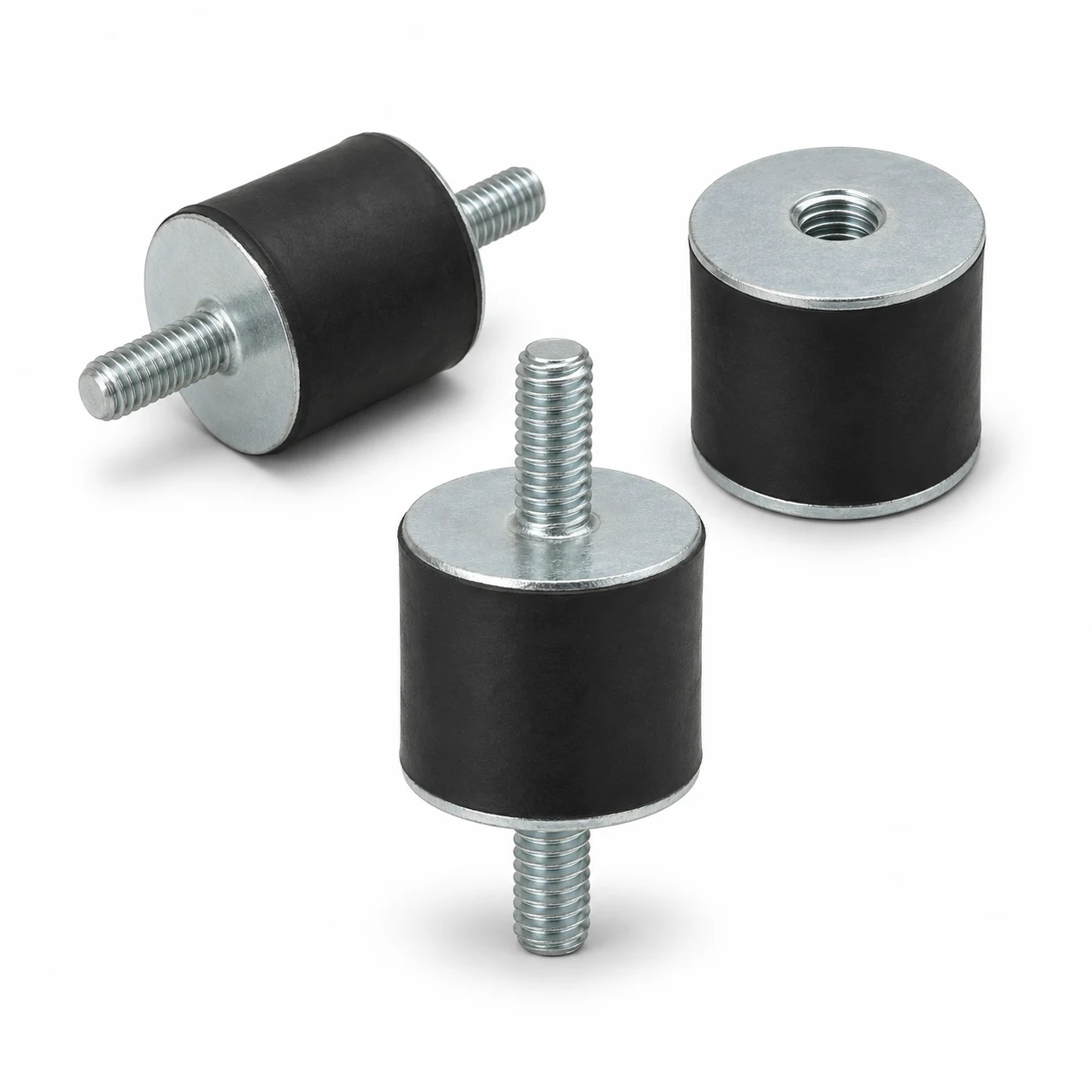
Cylindrical mounts, also called rubber bobbin mounts, use an elastomer body bonded to metal end fittings to help isolate equipment vibration. The compact cylindrical form suits installations with limited mounting space. Select the fixing arrangement, rubber dimensions and compound together with the load per support, excitation frequency and permitted movement. Matching the external dimensions alone does not establish equivalent performance.
Threaded fixing arrangements
| Mount | Connection | Drawing requirements |
|---|---|---|
| Male–male bobbin | Two external threaded studs | For mating threaded holes or through-hole fixings; specify both stud lengths. |
| Male–female bobbin | One stud and one threaded insert | For mixed fixing arrangements; specify stud length and usable insert depth. |
| Female–female bobbin | Two threaded inserts | For bolt attachment from both sides; check bolt engagement and clearance. |
Single-ended buffers are intended for stop or impact-duty review. They should be specified separately from two-ended equipment mounts. Supplier type letters differ; use the fixing geometry and drawing to identify a replacement.
Dimensions and performance
Specify rubber diameter D, rubber height H, thread size, stud projection and insert depth. Nominal size and Shore hardness do not define a load rating. Confirm load–deflection behaviour, dynamic stiffness, bond integrity and fatigue requirements for the intended installation.
Review compression and shear separately. Include start-up and shutdown conditions, and identify any tension or uplift. A retention or failsafe requirement needs a design review before selection.
Typical applications
- Fans and ventilation equipment
- Pumps and compressors
- Electric motors and generator auxiliaries
- Electronic control panels and auxiliary assemblies
Material directions
Specify the existing compound for replacement parts, or provide the operating environment for a material review. Hardness and geometry both affect stiffness.
- Natural rubber (NR): a common starting point for vibration isolation
- NBR: review for oil exposure and actual fluid compatibility
- Alternative compounds: review temperature, ozone and outdoor exposure
- Plated steel or stainless steel fittings: specify corrosion and thread requirements
What to include in an inquiry
- Rubber diameter D and height H, including dimensional tolerances
- Male–male, male–female or female–female fixing arrangement
- Thread diameter and pitch; stud length or effective insert depth at each end
- Equipment mass, number and location of supports, and centre of gravity
- Compression and shear loads, operating speed or excitation frequency, and allowable deflection
- Temperature, fluids, outdoor exposure and metal corrosion requirements
- Required quantity, drawing revision and load–deflection or dynamic validation requirements